

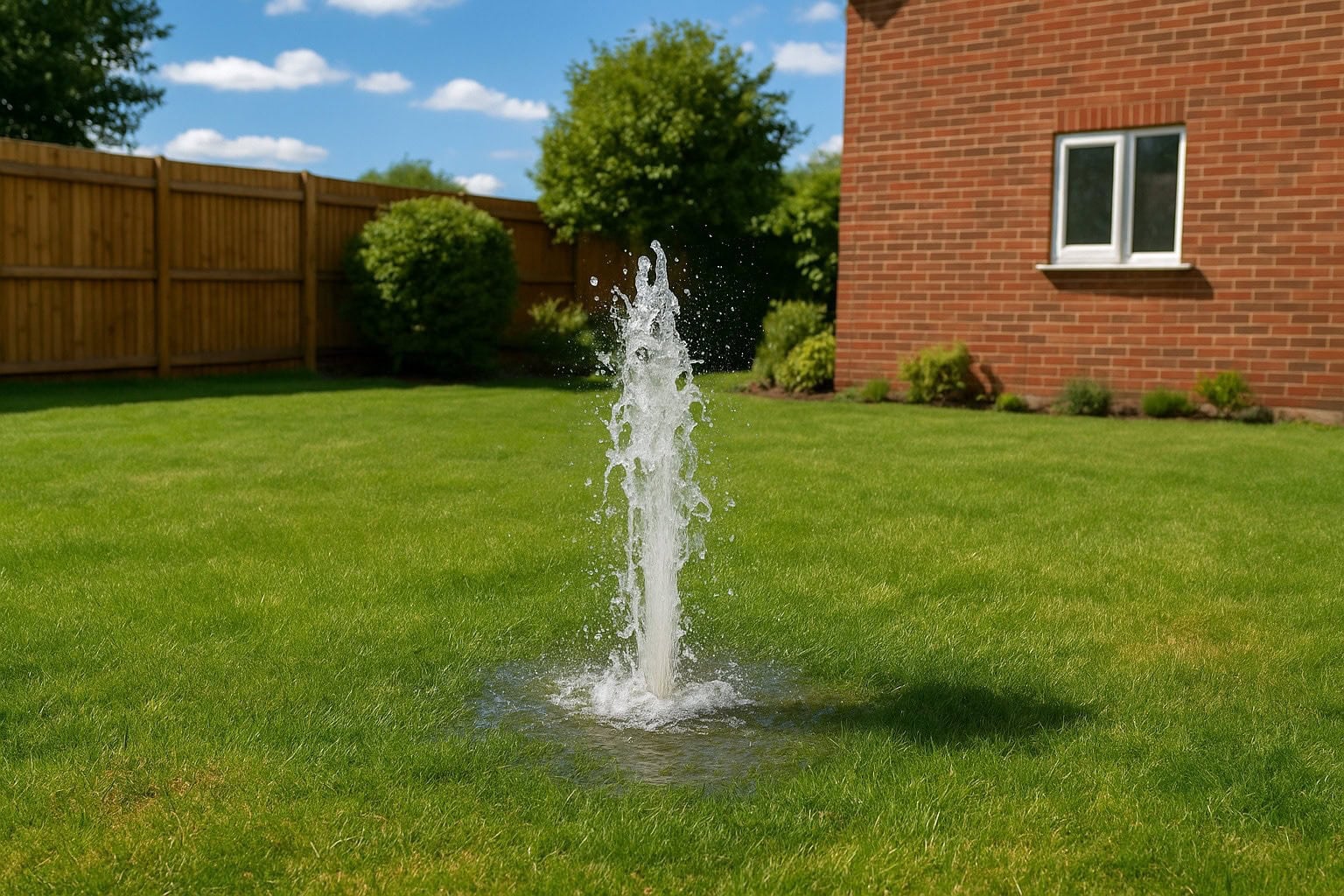
If you’ve noticed water appearing outside near your house — along walls, near foundations, or close to external surfaces — but there’s no sign of a leak inside, it can be difficult to know what’s causing it.
There are no dripping pipes, no damp patches indoors, and no obvious plumbing issue. Yet water is clearly present where it shouldn’t be.
This is often a sign of a problem developing below ground.
Why water can appear outside without an internal issue
Not all leaks show themselves inside a property.
When a pipe below ground develops a leak:
- Water escapes into the surrounding soil
- It travels through the ground toward the easiest exit point
- It may surface near walls, paths, or external areas
This means the first visible sign can appear outside, even though the issue is connected to buried pipework.
If you want to understand how underground leaks behave, see underground leaks explained.
Why it often appears near the house
Water tends to collect or emerge near structures because of how the ground is shaped and compacted.
This can happen because:
- Foundations and walls alter the flow of water underground
- Water follows paths of least resistance
- Lower areas near the house allow moisture to gather
As a result, the visible water may not be directly above the source of the problem.
What this usually indicates
If water is consistently appearing near your home with no internal cause, it often suggests:
- A leak in underground pipework nearby
- Water travelling through the ground from another location
- A developing issue that has not yet reached internal areas
The key point is that the source is hidden, not absent.
Why this shouldn’t be ignored
Because there’s no visible internal damage, it’s easy to delay action.
However, over time, this type of issue can lead to:
- Increasing water loss
- Worsening ground saturation near the property
- Potential impact on surrounding surfaces or structures
What appears minor at first can gradually become more serious.
How The Leak Hunter approaches this
The Leak Hunter will confirm whether the water is being caused by an underground leak and identify the exact source without unnecessary excavation.
This ensures the problem is clearly understood before any repair work begins.
To see how this works, visit how we find underground leaks.
Why visual signs can be misleading
One of the most common mistakes is assuming the visible water marks the location of the leak.
In reality:
- Water can travel underground before appearing
- The source may be further away than expected
- The surface only shows the end result, not the origin
This is why accurate detection is essential.
What happens once the source is identified
Once the leak is located, the repair can be planned in a targeted way.
This may involve:
- Accessing the pipe at the correct location
- Repairing or replacing the affected section
- Restoring the area once the work is complete
You can read more about this stage here: what happens after an underground leak is found.
Final thoughts
If water is appearing near your house with no internal leak, it’s worth investigating further.
The issue may not be inside the property — but it can still affect it over time.
The Leak Hunter will confirm the cause, locate the source accurately, and carry out the right repair — ensuring the problem is resolved without unnecessary disruption.
To see how we investigate and resolve underground leaks, visit underground leak detection.
Frequently asked questions
Do you only cover my area?
If you’re outside these areas, don’t worry — our team covers most of the South East, providing trusted leak detection services throughout London, Kent, Sussex, and Surrey.
Does this mean I have a leak inside my house?
Not necessarily. The issue may be external and underground, even if water appears near the property.
Can water travel from another area?
Yes. Water can move through the ground and surface away from the original source.
Should I investigate even if nothing is wrong inside?
Yes. External water issues can still indicate underlying problems that should be confirmed early.