

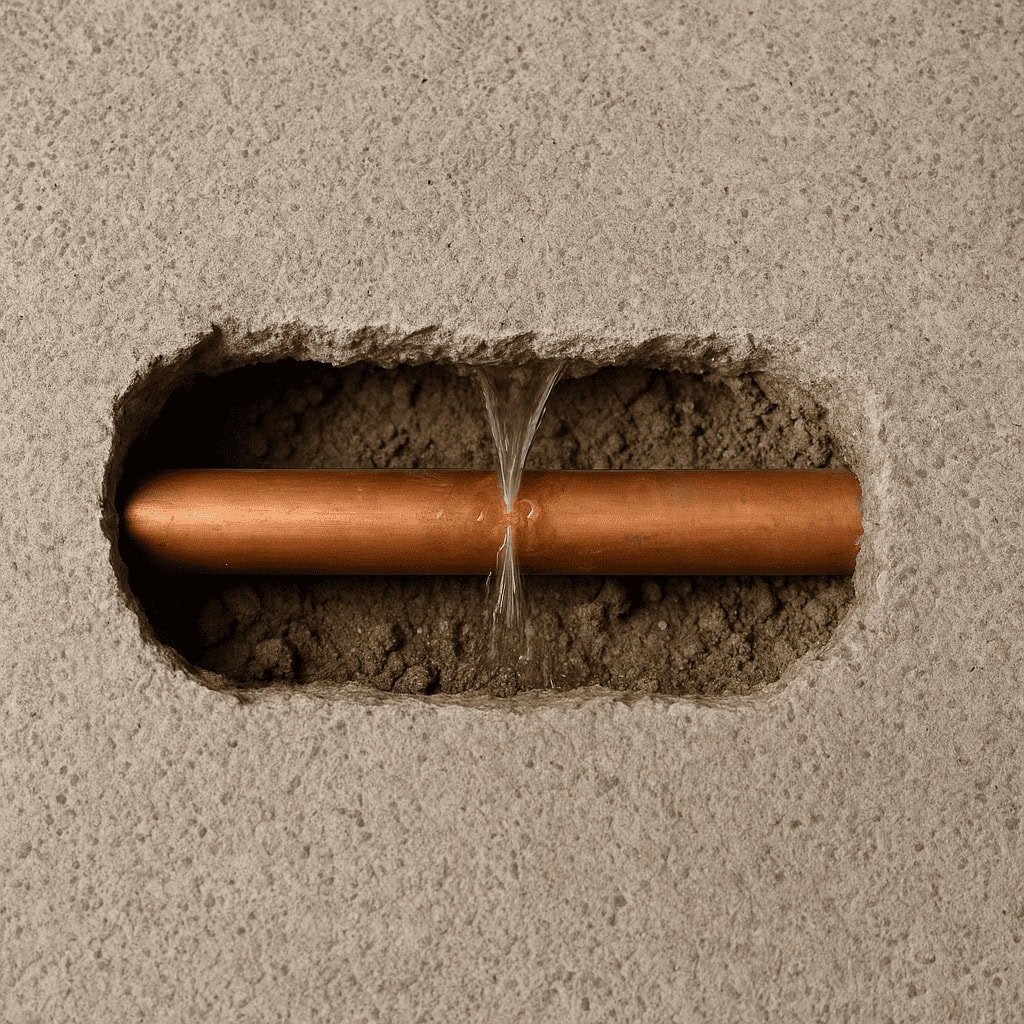
If you’ve found a damp patch on your floor, it’s natural to assume the leak is directly underneath it. In many cases, that’s the first place homeowners expect the problem to be.
However, in properties with a solid concrete floor or screed, leaks beneath the slab don’t always behave that way. The visible damp patch is often where the water has eventually reached the surface, not necessarily where the leak began.
Understanding how water travels beneath a concrete floor is one of the most important parts of locating the true source accurately.
Why leaks beneath concrete floors behave differently
When pipework leaks beneath a concrete floor, the escaping water rarely travels straight upwards.
Instead, it often follows the easiest route beneath the slab before eventually finding somewhere to appear at the surface.
- Water can spread beneath the concrete before becoming visible.
- Moisture follows paths of least resistance through the surrounding ground.
- Changes in the subfloor can redirect how water travels.
- The first visible damp patch may develop some distance from the leak itself.
This is why the damp area you can see is not always directly above the damaged pipe.
Why the visible damp patch can be misleading
It’s easy to believe the repair should begin where the floor looks wet.
In reality, the damp patch is often simply the point where moisture has managed to reach the surface.
- The leak itself may be several feet away beneath the slab.
- Water may travel before becoming visible.
- The damp patch often marks the exit point rather than the source.
Although this isn’t true in every case, it’s common enough that relying on the visible damp area alone can lead to unnecessary excavation in the wrong location.
How water moves beneath a solid floor
Once water escapes beneath a concrete floor, it behaves differently from water on the surface.
Depending on the surrounding ground and construction, it may:
- Spread sideways beneath the slab.
- Follow natural gaps or changes in the subfloor.
- Collect beneath one area before eventually surfacing elsewhere.
- Appear where resistance is lowest rather than where the leak began.
This is one reason beneath-slab leaks can be difficult to locate without specialist equipment.
Why guessing can make the problem worse
Because the visible signs don’t always match the leak location, opening the floor where the damp patch appears can sometimes miss the damaged pipe completely.
This can lead to:
- Unnecessary damage to unaffected areas.
- Extra repair costs.
- The real leak remaining undiscovered.
- Further disruption while the investigation continues.
Accurately locating the source first helps keep repairs as targeted as possible.
How The Leak Hunter investigates beneath-slab leaks
Visible damp patches provide valuable clues, but they rarely tell the whole story. The Leak Hunter uses non-invasive leak detection methods to trace hidden moisture back to its true source beneath the concrete floor before any repairs begin.
By identifying the exact location of the leak first, unnecessary excavation can often be avoided and repairs can be planned far more accurately.
Learn more here: how we find concrete floor leaks.
Why finding the true source matters
The objective isn’t simply to find where the floor is wet — it’s to locate the pipe that’s actually leaking.
Once the true source has been identified, repairs can usually be carried out more efficiently with less disruption to the property.
Final thoughts
If you’ve found a damp patch on your floor, don’t assume the leak is directly underneath it. In properties with solid concrete floors, water often travels beneath the slab before becoming visible.
The Leak Hunter specialises in locating the true source of beneath-slab leaks, helping avoid unnecessary excavation and ensuring repairs are carried out in the correct location.
To learn more, visit concrete floor leak detection.
Frequently asked questions
Is the damp patch always directly above the leak?
No. Water beneath a concrete floor often travels before reaching the surface, so the visible damp patch may not be directly above the damaged pipe.
How far can water travel beneath a concrete floor?
It depends on the construction of the floor and the surrounding ground. In some cases, moisture can travel several feet before becoming visible.
Can you locate the leak without breaking the floor first?
Yes. Specialist non-invasive leak detection equipment allows The Leak Hunter to investigate beneath-slab leaks before controlled access is carried out.
Do you only cover my area?
If you’re outside these areas, don’t worry — our team covers most of the South East, providing trusted leak detection services throughout London, Kent, Sussex, and Surrey.