

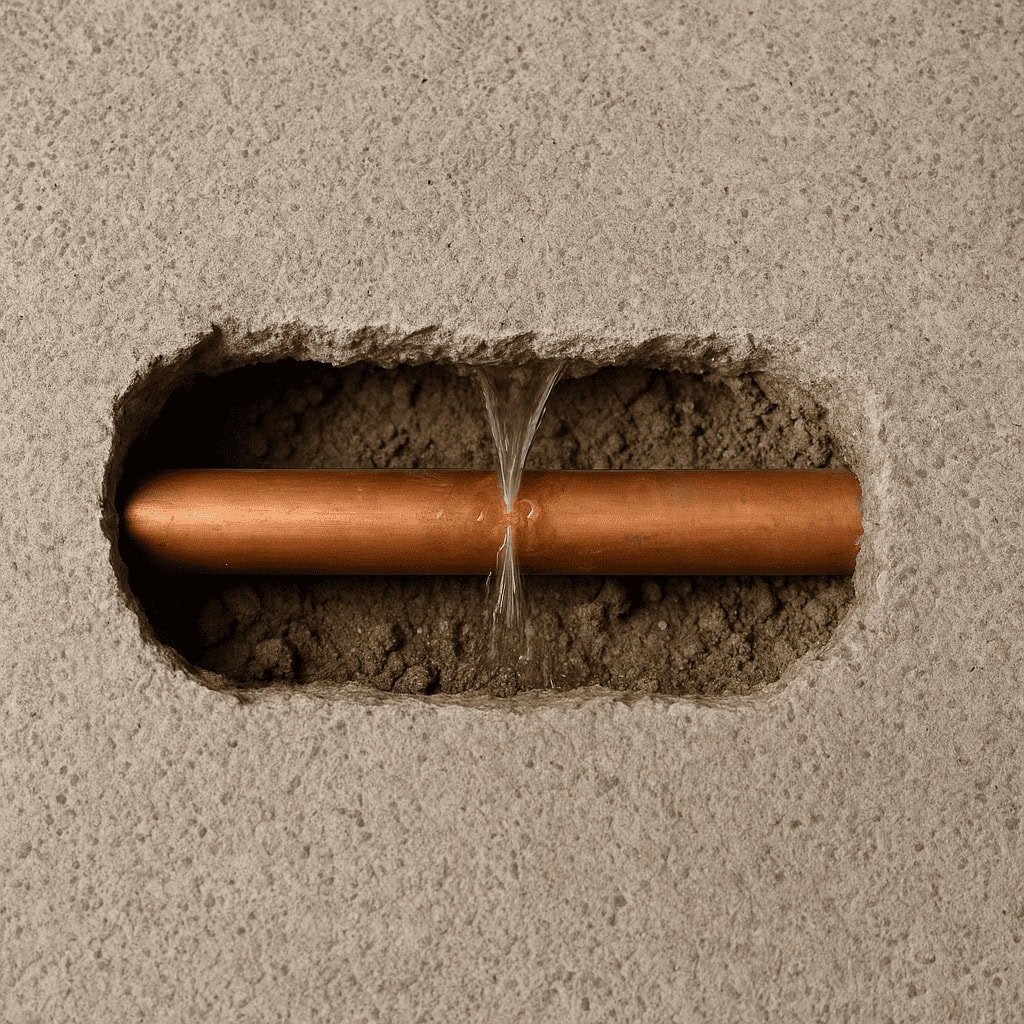
If you notice water coming up through your floor tiles, it’s a strong sign something is happening beneath the surface. There’s no visible pipe and no obvious source — just moisture appearing from below.
In properties with solid floors, this usually points to a specific issue. The system beneath the concrete is no longer sealed, and moisture is being forced upward.
This isn’t typical surface damp or a spill. It’s a symptom of movement below the floor — and that needs to be confirmed properly.
Why Water Comes Up Through Floor Tiles
Floor tiles sit on a solid base, usually concrete or screed. If water appears on top, it means moisture is travelling upward from below.
This happens when a pressure imbalance builds under the floor:
- Water escapes beneath the slab
- Moisture builds within or under the concrete
- That moisture finds a path upward through joints or gaps
What you see on the surface is only where the water is able to escape — not where the problem starts.
Why This Points Below the Floor
Water rising through tiles behaves differently to normal damp or surface moisture. The direction of travel is the key indicator.
- The movement is upward, not across
- The source is below the floor structure
- The visible water is the end point, not the origin
In most cases, this means there is a leak beneath the concrete floor that needs to be traced accurately.
What People Often Misread
It’s common to assume this is caused by everyday factors such as cleaning water, condensation, or general damp.
- Spills soaking into grout
- Condensation on cold tiles
- General moisture in the property
These can create surface dampness, but they don’t force water up through a solid floor. If moisture is rising, it’s being driven from below.
Why This Shouldn’t Be Ignored
When water is coming up through tiles, there is ongoing moisture beneath the floor. Left unresolved, this doesn’t stabilise — it develops.
- Moisture continues to build under the slab
- Flooring materials can begin to move or degrade
- The repair becomes more extensive over time
The earlier the source is confirmed, the more controlled the solution will be.
How The Leak Hunter Solves This
The Leak Hunter will confirm whether a leak exists beneath the concrete floor and trace it to the exact point of failure. This is done without unnecessary disruption, so only the correct area is accessed.
You can see how we approach this here: how we find concrete floor leaks.
Why the Surface Doesn’t Tell the Full Story
The visible water is only part of the issue. Beneath the surface, moisture can travel before it finds a way out.
- The leak may be deeper within or below the slab
- Water may spread before rising
- The wet area is rarely the source location
This is why accurate detection is critical before any repair work begins.
What Happens Once Confirmed
Once the leak is identified, the repair is controlled and targeted. Only the necessary area is accessed, and the system is restored properly.
- Precise access to the affected section
- Repair of the pipe or failure point
- Restoration of the floor surface
Final Thoughts
If water is coming up through your floor tiles, it’s not random and it’s not surface-level. It’s a sign of a deeper issue within or beneath the floor structure.
The Leak Hunter will locate the source, confirm the cause, and resolve it properly — so the problem doesn’t return.
For a full overview of the service, visit Concrete Floor Leak Detection.
Frequently Asked Questions
Do you only cover my area?
If you’re outside these areas, don’t worry — our team covers most of the South East, providing trusted leak detection services throughout London, Kent, Sussex, and Surrey.
Can water really come up through tiles?
Yes. When moisture builds beneath a solid floor, it can be forced upward through joints or gaps in the surface.
Does this always mean there’s a leak?
Not always, but it is a strong indicator that something below the floor needs to be investigated.
Will the floor need to be removed?
No. Detection is carried out first to locate the exact source, so only the necessary area is accessed.