

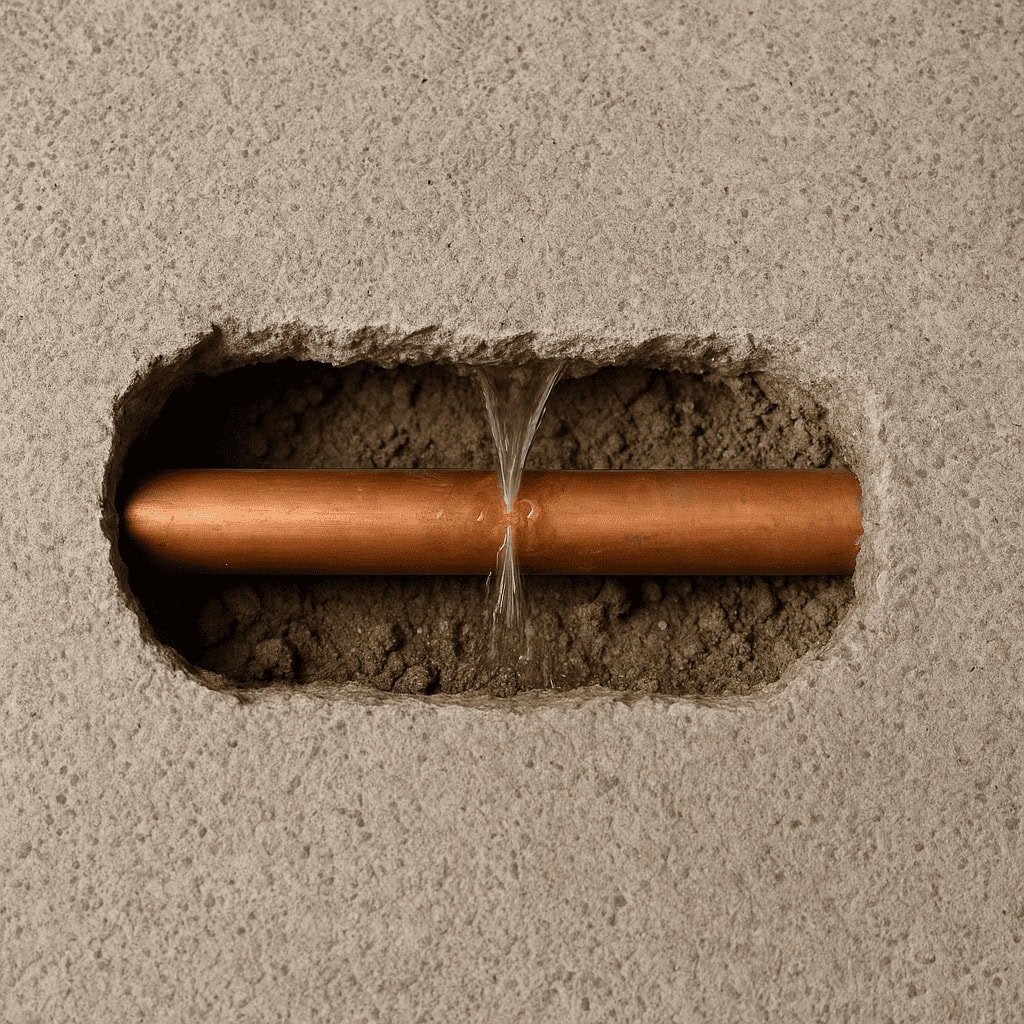
If you suspect a leak beneath your floor but can’t see anything obvious, it puts you in a difficult position. There’s no visible water, no clear damage — just a sense that something isn’t right.
In properties with a solid floor (typically a concrete slab or screed), this situation is more common than you might expect. Pipework runs beneath the surface, so problems can develop quietly before anything becomes visible.
At this point, most homeowners are asking the same thing: is it better to wait, or should you investigate now?
When a leak is suspected but not confirmed
This stage is often unclear. You may not have proof of a leak, but something doesn’t feel normal.
Common early signs include:
- A patch that feels slightly damp or slower to dry
- A section of floor that feels different underfoot
- Subtle changes that don’t have an obvious explanation
These signs don’t always confirm a leak, but they rarely appear without a reason. In many cases, this is how a concrete floor leak begins.
To understand how these issues develop beneath the surface, you can read more here: how concrete floor leaks behave beneath the surface.
Why leaks under concrete floors are hard to confirm
Unlike visible pipework, anything beneath a solid floor is completely hidden. This makes it difficult to confirm what’s happening without proper investigation.
There are three main reasons for this:
- The pipework cannot be visually inspected
- Water can spread beneath the slab before reaching the surface
- Symptoms often appear gradually or inconsistently
This is why leaks under concrete floors often remain uncertain until they are properly tested.
What happens if you wait for clearer signs
It’s natural to wait until there’s obvious evidence before taking action. However, with hidden leaks, this approach can allow the problem to develop further.
Waiting can lead to:
- The leak spreading beneath the floor unnoticed
- Moisture building up over time
- More complex repairs once damage becomes visible
By the time a leak is clearly visible, it has often been present for some time.
When it makes sense to investigate properly
Professional detection becomes the right step when uncertainty continues or signs begin to repeat.
This typically includes situations where:
- You suspect a leak but cannot locate it
- Signs are becoming more noticeable over time
- There is no clear source despite ongoing concern
At this stage, investigation removes uncertainty and prevents guesswork.
You can see exactly how this process works here: how we find concrete floor leaks.
Why guessing often leads to unnecessary disruption
Without accurate detection, it’s easy to focus on the wrong area.
This can result in:
- Unnecessary removal of flooring
- Investigating areas that are not affected
- Missing the true source of the problem
Getting a precise diagnosis first avoids unnecessary disruption and ensures the right work is carried out.
How The Leak Hunter resolves this
The Leak Hunter will confirm whether a leak is present and pinpoint its exact location beneath the floor using non-invasive detection methods.
We remove uncertainty before any repair begins, so the solution is targeted, controlled, and based on clear findings.
This ensures the problem is solved properly — not guessed.
What happens once a leak is confirmed
Once the source is identified, the repair can be planned with precision.
This usually involves:
- Accessing the exact point of the leak
- Repairing the affected pipework
- Restoring the floor once the issue is resolved
Final thoughts
If you suspect a leak beneath a concrete floor but can’t confirm it, waiting rarely provides clarity. Hidden leaks tend to progress quietly rather than resolve themselves.
The Leak Hunter will confirm the presence of a leak, locate it accurately, and carry out the correct repair — ensuring the issue is resolved without unnecessary disruption.
For a full overview of the service, visit concrete floor leak detection.
Frequently asked questions
Should I investigate a suspected leak under a concrete floor?
If the signs are not going away or feel unusual, it’s usually worth investigating. The Leak Hunter can confirm whether a leak is present and locate it accurately without unnecessary disruption.
Can there be a leak even if there is no visible water?
Yes, this is common with solid floors. Water can remain beneath the surface for some time before appearing above ground.
Will I need to remove my floor to find the leak?
No. The Leak Hunter uses non-invasive methods to locate the exact source first, so any access is minimal and controlled.
What happens if I ignore a suspected leak?
In most cases, the issue will continue to develop beneath the floor. Early confirmation helps avoid more complex repairs later.