

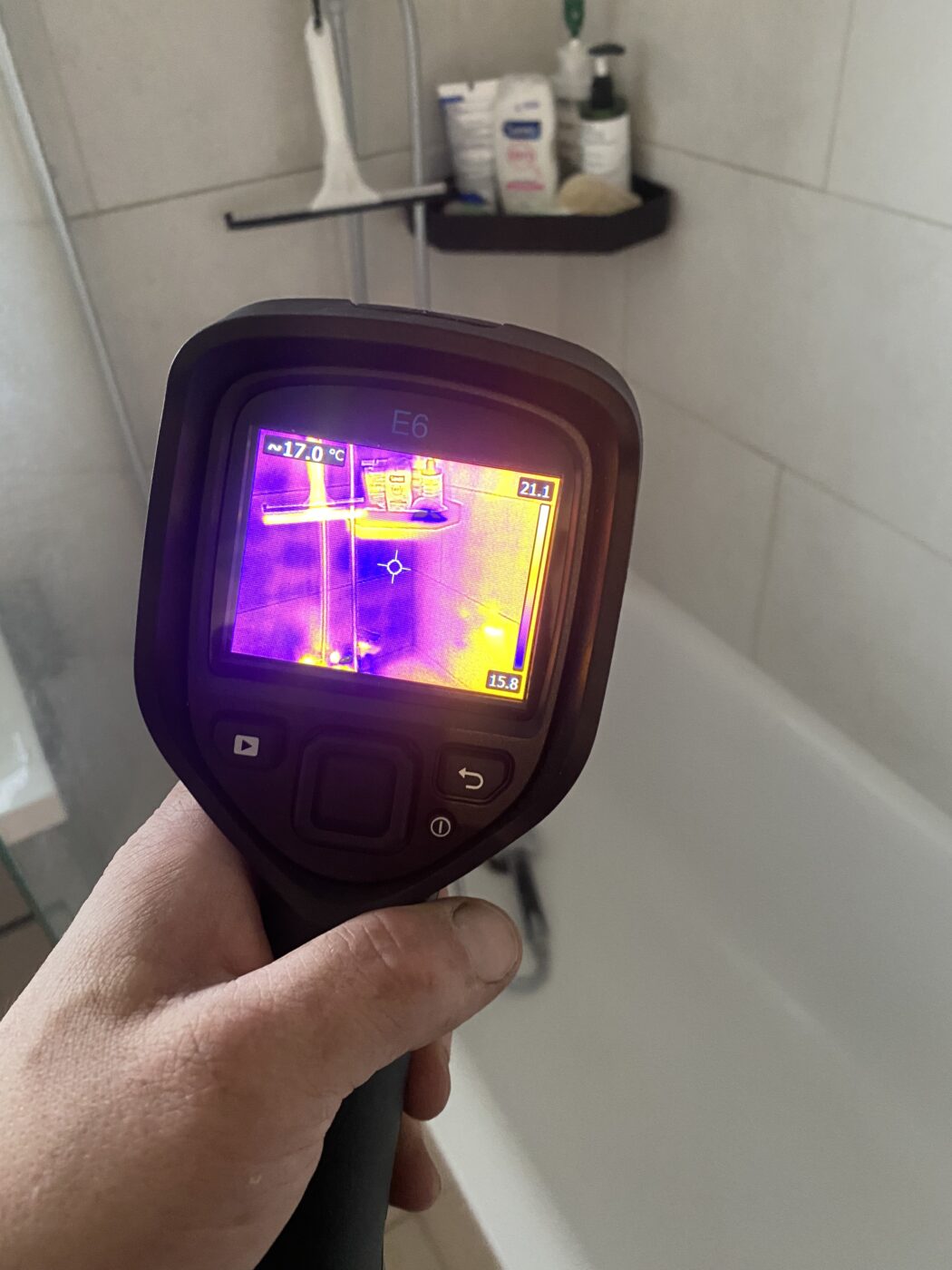
Thermal imaging leak detection is a non-destructive method used to help locate hidden leaks by identifying temperature differences across surfaces. Using infrared cameras, leak investigators can visualise heat patterns that may indicate the presence of moisture, water movement or concealed pipework.
It is one of several techniques used during leak investigations. The most appropriate method depends on the type of leak, the pipe material, the construction of the property and the evidence available on site. To explore related techniques, visit our Leak Detection Technology page. You can also view our main Leak Detection service page for a wider overview.
What Thermal Imaging Leak Detection Is
Thermal imaging uses infrared cameras to measure surface temperatures and display them as a visual image. Different temperatures appear as different colours or shades, allowing areas of interest to be identified quickly.
In leak detection, thermal imaging can help identify unusual temperature patterns that may be associated with escaping water, moisture movement or concealed heating pipework.
Importantly, thermal imaging does not detect water directly. It detects temperature differences. Those temperature differences then need to be assessed within the wider context of the investigation.
How Thermal Imaging Works
When water escapes from pipework, it can affect the temperature of surrounding materials. Depending on the circumstances, an area may appear warmer or cooler than the surfaces around it.
An infrared camera detects these temperature variations and presents them as a thermal image. This can help identify areas that require further investigation.
- An infrared camera scans the surface.
- Temperature variations are recorded.
- Areas of interest are identified.
- Thermal patterns are assessed alongside other evidence.
- Further testing may be carried out where required.
Thermal imaging is often used to narrow down a search area before more targeted testing takes place.
When Thermal Imaging Is Most Useful
Thermal imaging is most effective where a leak is creating a measurable temperature difference that can be detected at the surface.
It is commonly used for:
- Underfloor heating investigations.
- Hot water pipe leaks.
- Central heating leaks.
- Leaks affecting ceilings and upper floors.
- Water ingress investigations.
- Moisture investigations where water movement is suspected.
In suitable conditions, thermal imaging can quickly reduce the search area and provide valuable information without causing unnecessary disruption.
What Thermal Imaging Cannot Detect
One of the most common misconceptions is that thermal imaging cameras can see water through walls or floors. They cannot.
Thermal imaging does not see through building materials and it does not detect water directly. Instead, it identifies surface temperature differences that may be associated with moisture, heating systems, heat loss or other building-related factors.
This means that a thermal image alone does not confirm the presence of a leak. It simply provides evidence that requires further assessment.
What Can Cause Similar Thermal Patterns?
Not every thermal anomaly is caused by a leak. Temperature differences can also be created by heating pipework, underfloor heating systems, insulation gaps, draughts, solar gain, electrical equipment and changes in building materials.
For example, a warm patch on a floor could indicate a leaking hot water pipe, a heating pipe, underfloor heating or simply an area receiving more heat from sunlight. Without further investigation, it is not possible to know the cause from a thermal image alone.
This is why thermal imaging findings are assessed alongside other evidence before conclusions are reached.
Why Thermal Images Need Interpretation
Capturing a thermal image is only part of the process. The image still needs to be interpreted correctly.
An experienced leak investigator understands how building materials, heating systems, insulation, ventilation and environmental conditions can influence thermal patterns. This information is then considered alongside other test results to determine the most likely cause.
For example, a warm area on a floor may be caused by a heating pipe, underfloor heating, solar gain through a window or a leaking hot water pipe. The thermal image alone cannot distinguish between these possibilities without further investigation.
This is why thermal imaging should be viewed as a tool for gathering evidence rather than a standalone answer to every leak investigation.
What Affects Thermal Imaging Results?
Thermal imaging can be highly effective, but results depend on the conditions present at the time of the inspection.
- Pipe depth and pipe insulation.
- The temperature of the water within the system.
- Whether the leak is active at the time of testing.
- Ambient temperature and weather conditions.
- Air movement and ventilation.
- Surface finishes and floor coverings.
- Solar gain through windows and glazing.
- The construction and insulation of the building.
Where temperature differences are limited or concealed pipework is deeply buried, additional testing methods may be required.
How Thermal Imaging Fits With Other Leak Detection Methods
Thermal imaging is rarely used in isolation. It forms part of a wider leak investigation where findings are supported by other diagnostic methods.
It is commonly used alongside:
- Acoustic Leak Detection to investigate leak noise from pressurised pipework.
- Tracer Gas Leak Detection where a more precise leak location needs to be confirmed.
- Pressure Testing to confirm whether a system is losing water.
- Moisture Mapping to establish whether moisture is present and how it has moved through a property.
- Endoscope Inspection where concealed spaces need to be examined visually.
The objective is not simply to capture a thermal image. The objective is to build enough evidence to identify the most likely cause and location of the problem.
Why Thermal Imaging Matters
Thermal imaging helps narrow down hidden leaks and moisture issues without unnecessary disruption. It can quickly identify areas that require further investigation and help avoid unnecessary access work.
Used correctly, thermal imaging provides valuable visual evidence. Interpreted correctly, it helps guide the wider investigation and supports more targeted testing and repairs.
Frequently Asked Questions
Can thermal imaging detect water leaks?
Thermal imaging can help identify temperature patterns associated with leaks, but it does not detect water directly. The findings must be interpreted alongside other evidence.
Can thermal imaging see through walls?
No. Thermal imaging measures surface temperatures and cannot see through walls, floors or ceilings.
Does thermal imaging always find a leak?
No. Thermal imaging is one of several diagnostic tools. Its effectiveness depends on whether the leak is creating a measurable temperature difference that can be detected at the surface.
Need Help With a Hidden Leak?
Every leak investigation is different, and no single technology is suitable for every situation. The most effective approach depends on the type of leak, the pipe material, the construction of the property and the evidence available on site.
To learn more about hidden leak investigations, visit our Leak Detection hub page. If you need advice about a suspected leak or would like to discuss an investigation, please contact us and we will be happy to help.


